Happy Chinese Valentine’s Day!
Unlike International lover’s day - aka Valentine’s Day - which follows a set annual date, the Chinese version fluctuates according to the 7th day of the 7th lunar Month, known as the Qixi — Double Seventh Festival. This year (2026) in the Gregorian calendar it falls on 19 August.
Seven is ‘Qi’ in Chinese and ‘Xi’ means night, in ancient Chinese - so Qi xi means the evening of the seventh day of the seventh month. Also Xi Que 喜鹊 means Magpie (more on magpies link below). ‘Xi’ can mean ‘happiness’ because the first character Xi is the same word as happy (xi 喜). The wording is important, as the time of day plays a role in the significance of the Festival.
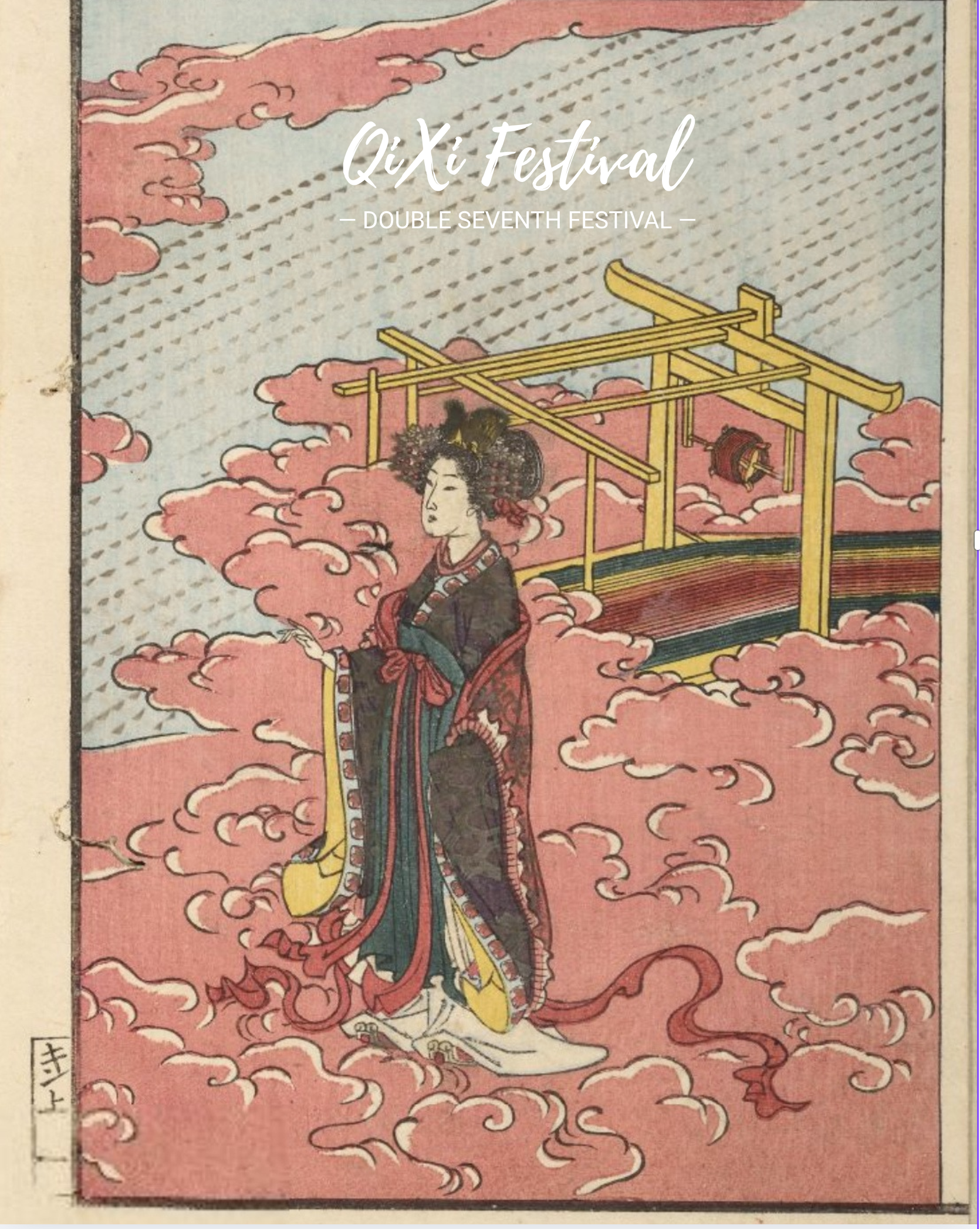
The roots of the festival also have meaning to the Ancient Chinese assigning names to their calendar months. The seven lunar month was known as ‘Skills’ Month, when women’s dexterity in all things domesticated was celebrated, especially the skill of needlework. Asian legend and lore speaks of the veneration of the Goddess Chih’nu — the daughter of the Jade Emperor and the Celestial Queen Mother. She was the weaver of the stars and their light - the Goddess of Weaving.
Legend says a young girl named Hua Lei ( Zhi Nu) aka Goddess Chih Nu, had notable weaving prowess and wove the heavenly skies and celestial stars. A weaver of seamless garments for the Gods. Ever since, the day is marked as a day of veneration for finessing needlework skills; the blessing of the Goddess was also sought with prayers for a good husband.
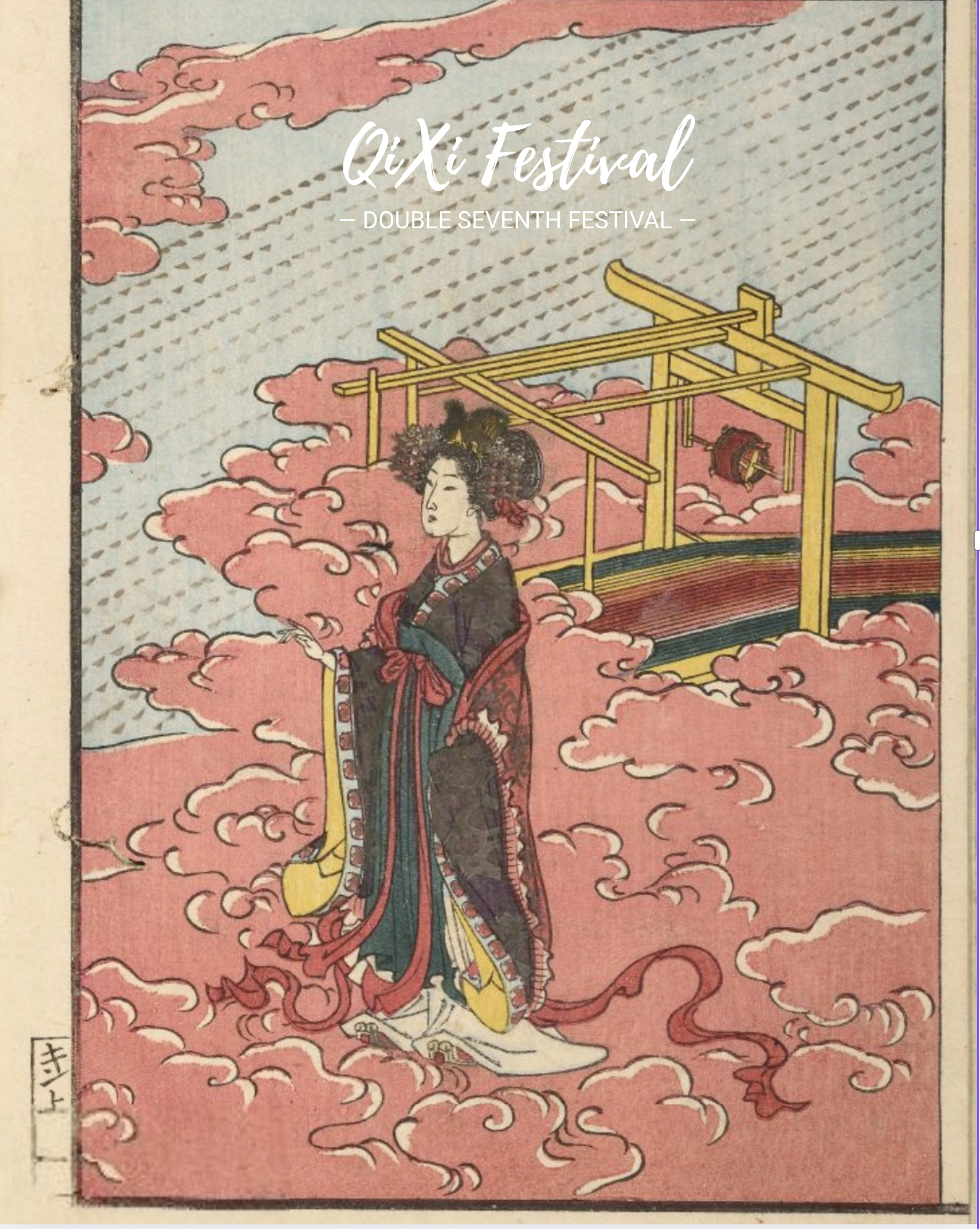
Over time the story unfolded as the ‘weaver girl’ who fell in love with a ‘Cow herd’ boy - Niu Lang (Cowherder) and Zhi Nu (Weaver Girl). Modernity now refers to this date as Chinese Valentine’s Day. (Note, some Chinese people also celebrate another date as ‘true’ Valentines Day.) The romantic legend of forbidden love, between the weaver girl now symbolized by Vega, and her Cowherd lover, symbolizing Altair - two stars separated by the Milky Way. Once a year; on the 7th day of the 7th lunar month, folklore dictates Queen of Heaven permits a flock of magpies form a ‘bridge’, over the Milk Way to reunite the lovers for one day only. A pair of magpies symbolizes marriage. (Like the magpie rhyme; two for joy.)
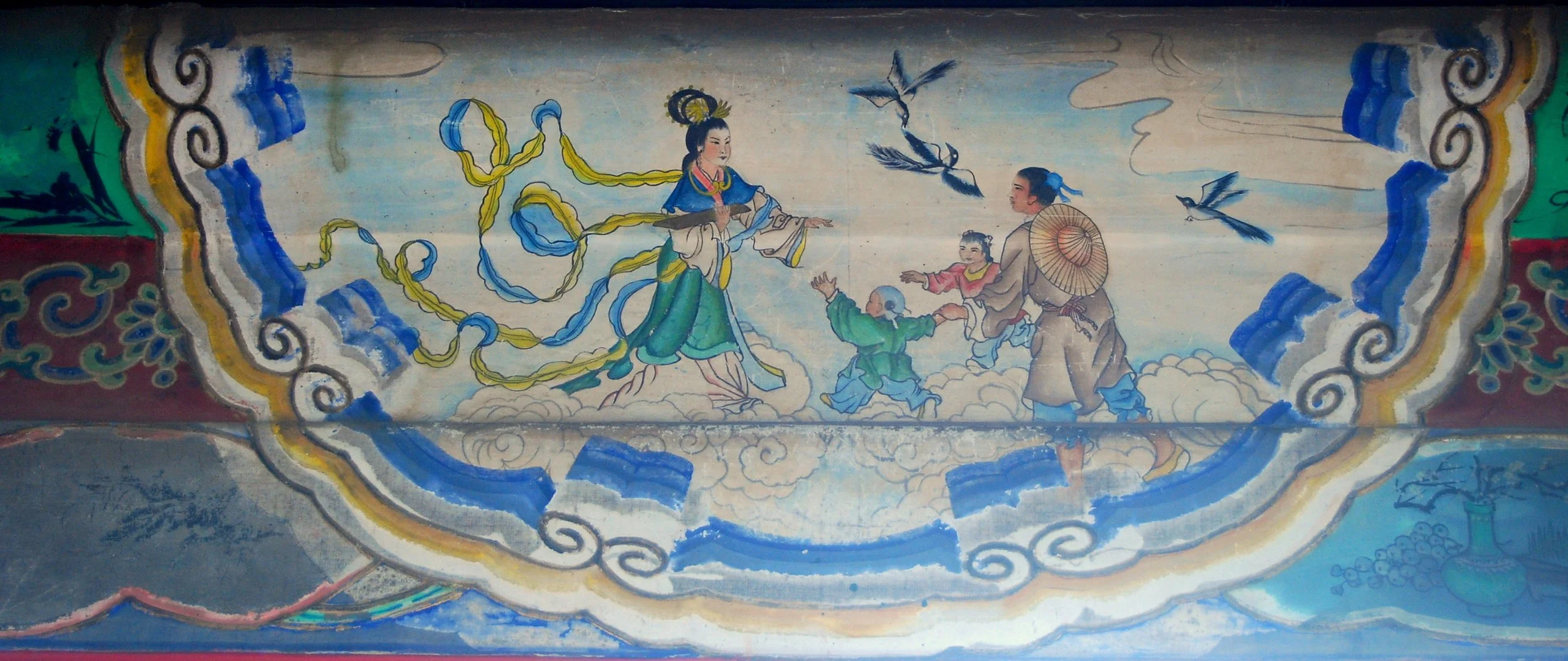
The reunion of the couple of The Weaver Girl and the Cowherd on the bridge of magpies. Artwork in the Long Corridor of the Summer Palace in Beijing. Creative commons public domain image

QIXI Volume 1 of Book of the Milky Way (Ginga zōshi) chester beatty CC4.0
STAR CROSSED LOVERS
Star gazing is a preoccupation among star crossed lovers on this Double Seventh evening, as folk gaze to see a third star appear and unite with Vega — the second-brightest star in the northern celestial hemisphere, brightest in Lyra Constellation —with Altair, brightest in the Aquila constellation. The third star is Deneb, forms an asterism, that’s known in astronomy circles as the ‘Summer Triangle’ in the Northern Hemisphere. Deneb is the ‘tail’ of the Cygnus (swan), acts as the marker of the aforementioned bridge. In Taoist traditions on this day Wang Tsz Kiao is said to have become immortal, riding on a white stork, perhaps a link to the Deneb? Vega is called "waqi” in Arabic, meaning ‘falling’ or ‘swooping’. I’m loving the synergy of swooping trait of magpies and swans who mate for life, not to mention the seven magpie adage! Interesting to note that Vega swoops below the horizon for 7 hours a day (depending on your location) but it’s visible in the night sky year round. So much so since ‘north’ shifts over time Vega was deemed the ‘North Star’ and apparently will rank so again in about 12,000 years, when the next precession occurs ¹.
The star Vega; along with North Star Polaris and the seven stars of the Big Dipper are used in the nine star Ki system and through out Chinese cosmology. Vega and Polaris represent Yin and Yang respectively - female and male.
VEGA IN OTHER TRADITIONS
In ancient Rome Vega’s morning setting marked the start of Autumn according to Richard Hinkley Allen. And in Polynesian cultures Vega was their annual star and marked their New Year, Pleiades now serves this marker in Maori’s. Vega is highly revered in astronomy, some say second to the Sun.
In Celtic culture ancient Irish astrological architectural sites are also believed to incorporate Vega in various cross and cross-quarter festival markers - the recent Aug lunation was also an astrological markers for Autumn.
Personally I just love this legend over the western observation of 14 February, which has no astrological significance — mind you todays double seven equals 14 and February is the second month in the western calendar.
As I now live in S.Hemi, I’m celebrated Spring where Imbolc (Spring) and Brigid lore is interwoven in Irish folklore. Also Chih’nu is the Chinese deity of arts and crafts, especially weaving who draws a strong parallel with Goddess Brigid in Pagan culture.
Perhaps the celestial star lore story is the seed of inspiration for Shakespeare’s coining of the term ‘star crossed lovers’? No matter the hemisphere or Lovers lore; here’s how to catch a glimpse of tonight’s celestial event.
*Link to identify Vega in the sky. Vega is almost directly overhead at mid northern latitudes on midsummer nights, and down under its skirts the horizon. Earth Sky website notes if you’re in the Northern Hemisphere, you’ll find beautiful, bluish Vega easily, simply by looking northeastward at mid-evening. Vega is so bright that you can see it on a moonlit night.
Southern Hemisphere peeps, this phenomenon is sometimes called the ‘Winter Triangle’ at this time of year down under. In latitudes of +90 and -40 the Winter Triangle is visible but Vegas appears upside down with Altair the peak star. . . Look North, low on horizon Deneb sinking right, Vega to the left and Altair on top …… S.H viewers also read more here.
ⓒ FENG SHUi iSM
¹ Joe Rao is Space.com's
“Living eye to eye with environmental wisdom”